





Secure checkout · Instant delivery to your email


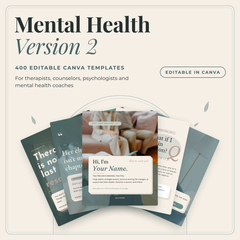
Version 2 · for therapists & counselors
400 new mental health posts, ready to make yours.
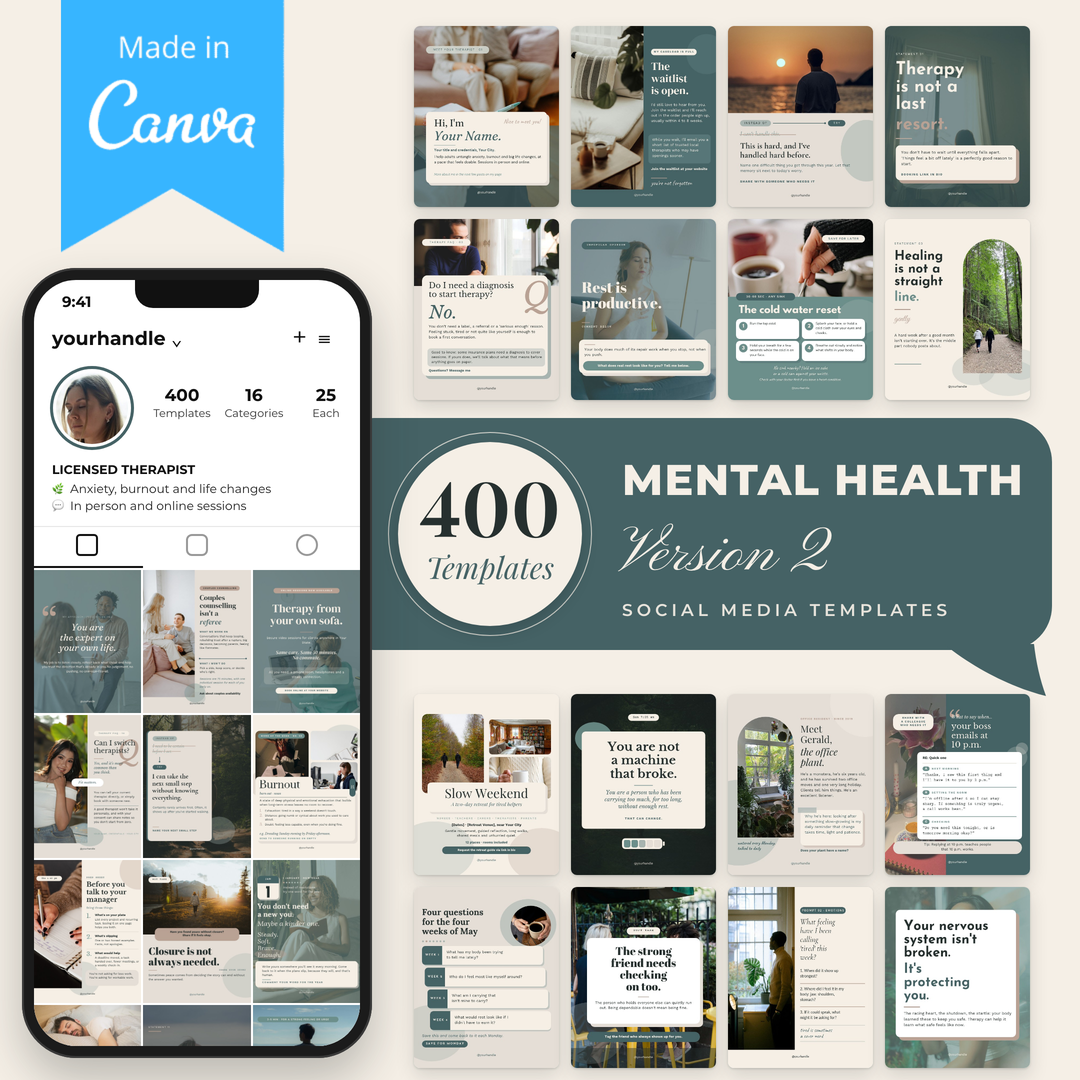
Mental Health Social Media Templates Version 2 is a completely new set of 400 editable Canva templates for therapists, counselors, psychologists and mental health coaches. Introduce your practice, answer the questions clients hesitate to ask and share tools your followers can use today.
- 400 templates
- 16 categories
- Photos you can swap
- No overlap with the 800 bundle

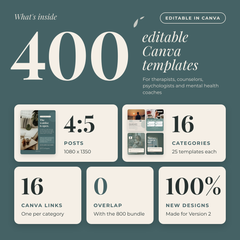
400editable templates
16categories
16Canva links
0overlap with the 800 bundle
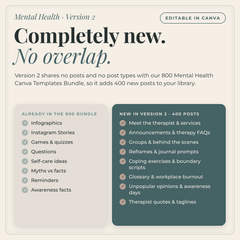
Completely new
Version 2 has no overlap with the 800 bundle.
Already own our 800 Mental Health Canva Templates Bundle? Version 2 adds 400 posts you don’t have yet. No post and no post type repeats.
The 800 bundle covers infographics, Instagram Stories, games, questions, self-care ideas, myths vs facts, reminders and awareness facts. Version 2 is built around your practice, practical tools and conversation starters: meet the therapist, services, therapy FAQs, reframes, coping exercises, boundary scripts, a mental health glossary, workplace burnout and more.

Who it’s for
Made for the people who hold space for others.
You know what you want to say. These templates give it a calm, professional look, so your time goes to your clients instead of the layout.
- Therapists
- Counselors
- Psychologists
- Mental health coaches
- Social workers
- Group practices
16 categories, shown with real pages
What’s included in this bundle.
All 400 mental health social media templates, category by category. Introduce your practice, answer common questions, share coping tools and start conversations. Each category is shown with real pages from its Canva file, so you can see the designs before you buy.
25 Meet the Therapist Templates
Introduce yourself with magazine-style portrait layouts and serif headlines like ‘Hi, I’m Your Name,’ ‘Why I became a therapist’ and ‘Am I the right therapist for you?’ Other posts explain your credentials in plain English, how a session works, what trauma-informed means in your room and the book that shaped your approach. Therapists and coaches use them so new followers can get to know them.

25 Services and What to Expect Templates
Walk prospective clients through how working with you actually goes, styled like pages from a printed welcome booklet with chapter tabs, numbered stops and form-style rows over real photos. Topics include your first session, the 15-minute call, how booking works, fees said plainly, questions to ask your insurance provider, rescheduling, confidentiality and in person versus online. Practices use them to answer common questions before the first appointment.

25 Practice Announcement Templates
Share practice news with notice-card layouts set over full-bleed photos with soft teal, sage, ink or mist overlays. Posts cover open client spots, a new waitlist, couples counseling, a new office location, holiday hours, evening and Saturday availability, reduced-fee spots, insurance network updates, cancellation policy changes, an open house and new groups. Therapists use them to keep current and future clients informed about what is changing.

25 Therapy FAQ Templates
Answer the questions people hesitate to ask, set as calm Q&A cards over photos, split layouts and tinted full-bleed frames. Questions include whether therapy is confidential, what happens in the first session, what if I cry, do I have to talk about my childhood, can I switch therapists and what if I see you in public. Clinicians use them to make starting therapy feel more familiar.

25 Group and Workshop Templates
Promote support groups and workshops with layouts that look like printed invitations, notched tickets and event programs. Examples include a grief group, a circle for new parents, a teen group for ages 14 to 17, Walk and Talk Saturdays, a live Ask a Therapist session, a speaking invitation, save-the-date cards and a three-step sign-up guide. Practitioners use them to announce dates and explain what a first night at group is like.

25 Behind the Scenes Templates
Show the human side of your practice with scrapbook-style photo diary pages. Posts include a Tuesday in the practice, your tea order decoded, Gerald the office plant, why the tissues are within reach, what happens in the 10 minutes between sessions, why you sit at an angle and why you don’t reply after 6 pm. Therapists use them to share candid moments from their week.

25 Reframe Templates
Each post shows a heavy thought turning into a kinder one, built as a before-and-after with layered type over tinted photos. Reframes include ‘This is hard, and I’ve handled hard before,’ ‘Her chapter 20 isn’t my chapter 3,’ ‘Mistake to information’ and the Catch it, Check it, Change it sequence. Counselors and coaches use them to share everyday self-talk ideas with their followers.

25 Journal Prompt Templates
Give followers something to write about with prompts set like pages from a linen notebook in elegant italic type, over real everyday moments. Prompts ask what feeling has been called ‘tired’ this week, what rest looks like when no one is grading it, which boundary resentment points to and who has quietly shown up for you. Therapists and coaches share them for weekly reflection.

25 Coping Exercise Templates
These are step-by-step practice cards, each with a time chip, numbered steps and a handwritten tip, set over real photos. Exercises include 5-4-3-2-1 grounding, box breathing, a 60-second body scan, the butterfly hug, the double-inhale sigh, thoughts on leaves and what to try when awake at 3 am, plus a post on when to reach for more support. Practitioners share them as short in-the-moment tools.

25 Boundary Script Templates
Hand followers exact words to say, set as speech bubbles over real moments. Scenarios include a boss emailing at 10 pm, an aunt commenting on your body at dinner, a coworker passing you their work, a relative asking when you’re having kids, an ex texting out of the blue and the guilt that shows up afterward. Therapists and coaches use them to model kind, clear ways to say no.

25 Mental Health Glossary Templates
Explain common terms in plain language with entries styled like a linen-bound pocket dictionary, with large serif headwords. Words include rumination, window of tolerance, co-regulation, fawn response, hypervigilance, attachment styles and earned security, plus comparison posts like burnout or stress, and interactive formats such as ‘Use it in a sentence’ and ‘Which word fits.’ Clinicians use them for psychoeducation that is easy to read and save.

25 Workplace Burnout Templates
Calendar blocks, email headers, memo cards and out-of-office notices set a calm office look over photos of people at work and at rest. Topics include stress versus burnout, talking to your manager, planning a mental health day, the Sunday 4 pm feeling, better check-in questions than ‘How are you,’ returning to work and a shutdown sentence. Therapists and coaches use them for posts aimed at working professionals.

25 Unpopular Opinion Templates
Start conversations with soft but confident takes set as bold serif pull-quotes over real moments, each with a one-line reason and an invitation to reply. Opinions include rest is productive, closure is not always needed, self-care is mostly boring, you don’t have to forgive to heal and therapy isn’t only for a crisis. Therapists and coaches use them to share their perspective and invite comments.

25 Awareness Days Templates
Mark the mental health calendar with almanac-style pages, each with one gently circled date over a seasonal photo. Posts cover January heaviness and Blue Monday, Stress Awareness Month in April, Mental Health Awareness Month in May, men’s mental health, loneliness, back to school, suicide prevention, World Mental Health Day on October 10 and the holidays. Practitioners use them to plan timely, thoughtful posts across the year.

25 Therapist Quote Templates
These are short, quotable lines set like museum placards or pressed bookmarks over quiet photos. Lines include ‘Slow progress is still progress,’ ‘You don’t have to earn kindness from yourself’ and ‘The bravest sentence I hear in my office is: I think I need help.’ Therapists share them as save-worthy posts that reflect how they talk with clients.

25 Tagline and Statement Templates
These are bold one-line statements, sized to read clearly even as a thumbnail and styled like the cover line of a wellness poster. Lines include ‘Therapy is not a last resort,’ ‘Feelings are information, not instructions,’ ‘Boundaries are a form of care,’ ‘High-functioning doesn’t mean fine’ and ‘Here when you’re ready.’ Practitioners use them as feed anchors, profile highlights and statements of what their practice stands for.

400 Templates in totalPosts at 1080 × 1350 (4:5), in 16 Canva template links, one per category.
A look inside
Real photos, calm words.
Welcome booklets, notebook pages, speech bubbles, dictionary entries and photo-led quotes, with photos you can swap and room for your own details.


Swipe →
How it works
From template to post in three steps.
1
Open the Canva links
After purchase you get a PDF with 16 Canva template links, one for each category. Click a link and Canva opens your own copy. It works with a free Canva account.
2
Make it yours
Add your name, credentials, city and booking details, swap in your own photos and match your colours. Placeholders such as Your Name, Credentials and Your City show what to change, and Canva’s Find and replace changes @yourhandle on every page at once.
3
Check and post
Read each post and adjust the wording to your training, scope of practice and local guidelines. Then download and share, or schedule a month in one sitting.

Why it’s different
Made for therapists, not generic wellness.
Completely newNo post and no post type repeats from our 800 Mental Health Canva Templates Bundle, so the two work side by side.
Designs that change with the topicWelcome-booklet pages for services, notebook pages for journal prompts, speech bubbles for boundary scripts and dictionary entries for the glossary.
One calm paletteDeep teal, sage, sand and cream across all 16 categories, so your feed still looks like one brand.
Written with careGentle, plain-language copy with no cures or promised outcomes, ready for you to adapt to your own practice.
Real photosPhoto-led layouts with real people and everyday moments. Keep the photos or swap in your own.
Built for your feedEvery post is 1080 × 1350, the 4:5 portrait size for Instagram and Facebook.
Ready when you are
Spend your time on clients. The posts are ready.
Open the Canva links, add your details and post.
Choose your licence
Two ways to use this product
Both licences include the complete set of files and every bonus listed above. What changes is what you are free to do with them.
Personal Use
For your own brand
Use the designs across your own pages, your business, and your client work.
- ✓Post on your own social pages and website
- ✓Use for a client's brand — one licence per client
- ✓Fully editable — colours, fonts, text, images
- ✓Yours to keep. One payment, no subscription
Resell Rights · PLR
Sell it as your own product
Everything in Personal Use, plus the right to rebrand this and sell it under your own name.
- ✓Rebrand it and sell it as your own digital product
- ✓Set your own price and keep the full sale
- ✓List on Etsy, Shopify, Gumroad, Payhip or Stan Store
- ✓Use as a course bonus or paid membership content
Thinking of starting a digital product shop?
The Resell Rights licence is built for it. You get a finished, ready-to-sell catalogue without designing one from scratch. Everything arrives as files, so there is no stock to buy, nothing to print, and nothing to ship — which is why these are a common starting point for an Etsy or Shopify digital storefront.
Full terms for both licences, including resale pricing guidance, are on our Licence Information page.
Instant download
Lifetime access
Fully editable on Canva
Free future updates
How Does It Work?

- Choosing a selection results in a full page refresh.